
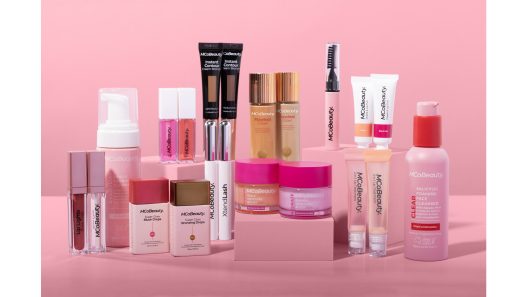



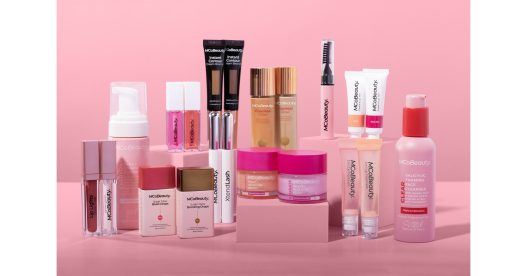
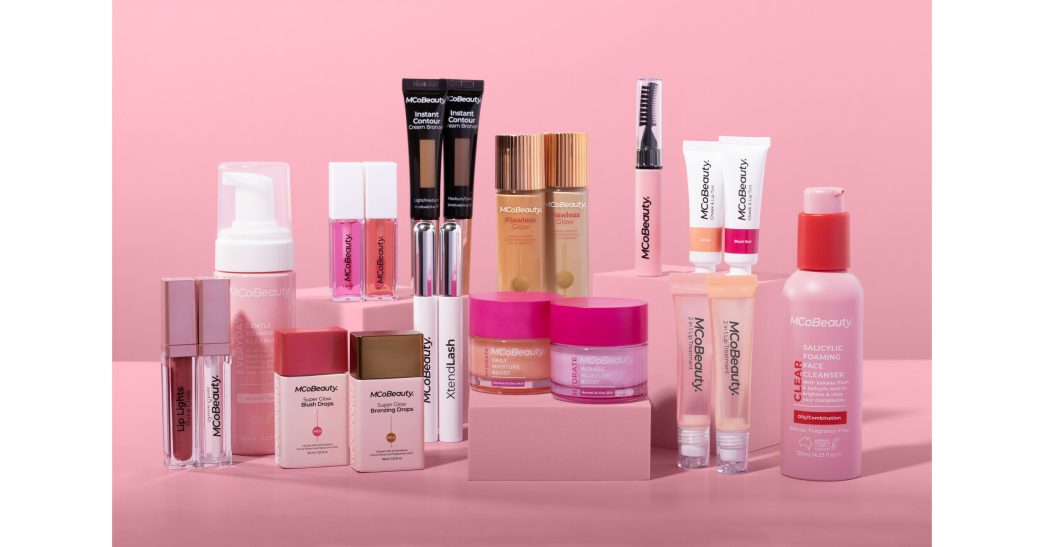
MCoBeauty has pushed the dupe economy beyond affordable functional alternatives and into a business model built around immediate visual recognition. The Australian company, valued in local reporting at approximately $1 billion, sells through Woolworths, Chemist Warehouse, Big W, Target in the United States, Amazon and other large retailers, and reportedly moves one product every two seconds. Its newest viral launches include low-priced products that closely reference recognizable prestige formats, while Sol de Janeiro and Glow Recipe have filed U.S. lawsuits alleging that MCoBeauty copied protected packaging, names and other distinctive brand elements. [1][2][3] The legal question concerns intellectual property. The larger market question is whether beauty has entered a “superdupe” phase in which resemblance is no longer an incidental acquisition tactic but the primary merchandising system.
The original beauty dupe asked a simple question: can a less expensive formula produce a comparable result?
The superdupe asks a different one: how many of the original product’s recognition cues can be transferred before the alternative becomes legally or culturally indistinguishable?
MCoBeauty’s strength lies in answering that question at retail speed. Its products often arrive with packaging silhouettes, color systems, product language or scent cues that allow customers to identify the prestige reference almost instantly. That legibility lowers customer-acquisition cost. The expensive brand already paid to teach the market what the product looks like and why it matters. MCoBeauty can enter after demand has been established and offer a lower-risk purchase.
The model is especially effective in mass retail. A customer shopping at Woolworths, Chemist Warehouse or Target can see the prestige resemblance without navigating a dedicated comparison page. The packaging performs the marketing directly on the shelf. TikTok then completes the loop through side-by-side demonstrations and “save versus splurge” content.
This differs from the long-standing practice of comparable formulas. The beauty industry has always followed successful textures, shades and ingredient stories. A strong innovation eventually becomes a category convention. Gel moisturizers, lip oils, bronzing drops and body mists are not ownable in perpetuity simply because one brand popularized them.
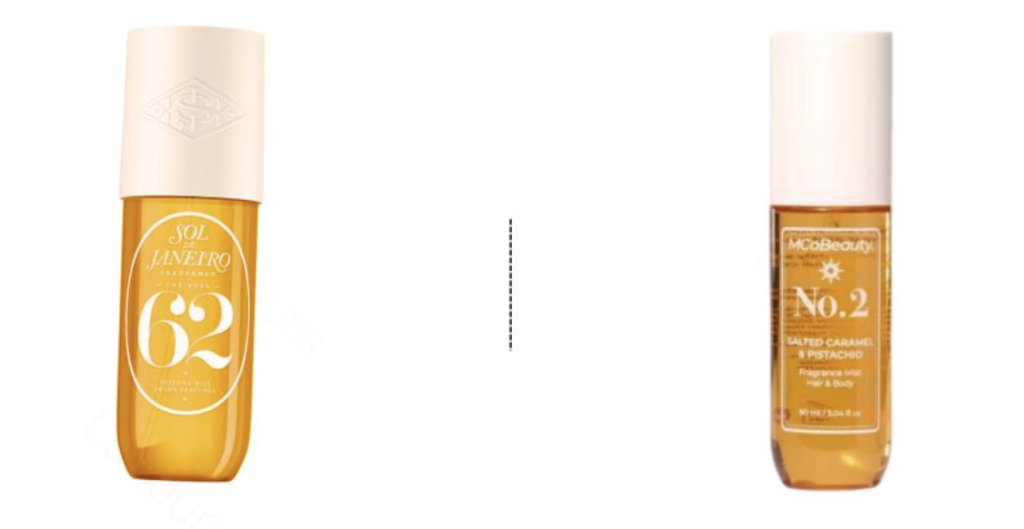
The conflict arises when the copy extends into distinctive trade dress. Sol de Janeiro’s complaint focuses on similarities to its Cheirosa fragrance-mist universe, while Glow Recipe’s case argues that MCoBeauty’s serum presentation too closely resembles Watermelon Glow Niacinamide Dew Drops. The plaintiffs are not claiming ownership of body mist or niacinamide. They are claiming that consumers encounter an imitation of a protected commercial identity. [3]
MCoBeauty’s public proposition is “luxe for less.” That wording places affordability and access at the center of the company’s defense. From the customer’s perspective, the brand is democratizing trend-led beauty that prestige companies have priced beyond routine experimentation. A $16 lip stain referencing a product priced around $45 gives shoppers participation without the prestige ticket.
The business case is powerful because prestige beauty itself has made products unusually easy to imitate visually. Distinctive bottles, bright color codes and highly specific applicators are designed to become recognizable in a fraction of a second on social media. The same characteristics that improve digital discovery provide a template for an imitator.
This creates an uncomfortable contradiction for prestige companies. They want packaging to become a cultural symbol but need courts and retailers to distinguish inspiration from consumer confusion. The more conventional a product category becomes, the harder it can be to defend the underlying functional idea. Packaging, trademark and trade dress become the enforceable perimeter.
The non-obvious reading is that superdupes are partly a consequence of beauty’s own price inflation and launch volume. Prestige brands have trained customers to encounter constant novelty at $30, $40 or $50 per item. Many shoppers still want the social participation but no longer believe every trend product justifies the price. A dupe does not have to match every technical detail. It has to capture enough of the experience for the customer to feel included.
MCoBeauty has industrialized that sentiment. It does not behave like a small copycat appearing after a product peaks. Its broad retail distribution, quick product development and marketing infrastructure allow it to place recognizable alternatives into major channels while the original remains culturally active.
That scale changes the risk. A prestige brand can ignore an obscure marketplace imitation. It cannot easily ignore a look-alike product placed nationally at Target or Chemist Warehouse. Retail visibility gives the dupe legitimacy, while the presence of multiple references under one brand turns copying into a customer expectation.
MCoBeauty also has an advantage traditional mass companies lack. Maybelline, L’Oréal Paris, Revlon and CoverGirl usually avoid packaging designed to recall one identifiable prestige rival because they manage long-term trademark portfolios and global corporate risk. MCoBeauty can operate more aggressively because cultural imitation is itself part of its identity.
The lawsuits could determine how far that strategy travels in the United States. Courts may distinguish between lawful competition around product function and unlawful copying of protected presentation. Even without a decisive judgment, litigation increases the cost of entering the U.S. and may force packaging redesigns, retailer caution or more extensive legal review before launch.
A loss would not destroy the dupe economy. It would push brands toward functional equivalence with more original visual systems. That could benefit companies such as E.l.f. Beauty, which frequently enters established categories at lower prices but has invested in a strong, independent corporate identity. E.l.f. has shown that value can become brand equity rather than dependence on the brand being copied.
A favorable result for MCoBeauty would encourage even closer imitation and place more pressure on prestige packaging teams to develop enforceable assets. It could also produce a wave of “inspired” products that become indistinguishable from counterfeits to the casual shopper even when the logo is different.
Retailers occupy a difficult position. Superdupes generate traffic and offer strong price-value stories. They can also antagonize prestige partners or expose the retailer to accusations that it is monetizing consumer confusion. Target’s assortment of MCoBeauty is particularly important because it brings the Australian model into one of America’s largest beauty environments.
The investor question is whether the model can produce durable brand value. A business dependent on referencing other companies may generate substantial sales while possessing limited independent product memory. Customers may remember “the cheaper version of X” rather than the MCoBeauty franchise.
The company can escape that trap by using the dupe engine to acquire customers, then developing original hero products and recognizable intellectual property of its own. The tension is that originality may reduce the instant legibility that powered the growth.
An eventual public listing, which has been discussed in Australian reporting, would make that distinction more important. Public investors would evaluate litigation exposure, retailer concentration, development speed and whether product demand survives when prestige references change. A $1 billion valuation requires more than viral comparison. It requires evidence that MCoBeauty itself drives purchase.
The category also has geographic asymmetry. Australian shoppers already understand the company as a major mass-beauty player. In the United States, its identity is more likely to be formed through the lawsuits, Target placement and specific dupes. The company must determine whether its aggressive Australian formula can be exported unchanged into a more litigious market.
Over the next 6 to 12 months, watch the Sol de Janeiro and Glow Recipe cases, retailer responses and whether MCoBeauty modifies U.S. packaging. Also watch the proportion of launches that can stand without a clear prestige comparison.
Superdupes convert someone else’s brand equity into a lower-priced customer shortcut. That can build an enormous sales business. The legal and strategic test is whether it can build an enormous brand.
Sources
[1] Business of Fashion, July 22, 2026, “Beauty Enters Its ‘Superdupe’ Era.”
[2] News.com.au, July 2026, “‘Shook’: $16 MCoBeauty Item Sparks Frenzy.”
[3] The Australian, April 2026, “MCoBeauty Faces U.S. Lawsuits Over Beauty Product ‘Dupes.’”
[4] MCoBeauty, U.S. assortment and “luxe for less” positioning.
[5] Target, MCoBeauty U.S. retail assortment.