


Byredo has never been easier to find or harder to define. Since Puig acquired a majority stake in the Swedish house in 2022 at a reported valuation of approximately €1 billion, the brand has expanded its retail footprint aggressively, launched its Absolu and Perfume Extract tiers, watched its founder walk out the door, and continued posting the kind of results that make its parent company’s investor calls. But the fragrance community is restless, the broader market is showing the first credible signs of fatigue, and the person who gave Byredo its authorial coherence has been gone since June 2025. Whether the brand is thriving, coasting, or quietly beginning to drift depends entirely on which signals you choose to weight — and all of them are worth examining.
What the Numbers Actually Say
Start with the financials, because they are more nuanced than either the bulls or the critics tend to acknowledge. Puig posted record full-year 2025 revenues of €5.04 billion, a 5.3% reported increase year-on-year, with adjusted EBITDA rising 7.8% to €1.045 billion.¹ Within that result, the Fragrances and Fashion segment — which includes Byredo alongside Carolina Herrera, Rabanne, and Jean Paul Gaultier — generated €3.65 billion, representing 72% of group sales. Crucially, Puig’s leadership specifically called out the niche fragrance category as the segment’s strongest performer, with Byredo cited by name as the driver of double-digit growth within that cohort.²
That is a genuinely strong result. But it requires context. The same Puig earnings cycle that celebrated niche fragrance growth also acknowledged something that deserves more attention than it received: the overall Fragrances and Fashion segment, the company’s dominant revenue engine, grew just 3.8% on a reported basis in 2025, a sharp deceleration from 13.6% growth in 2024.³ In Q3 2025 specifically, Puig flagged what it called a “softer” fragrance market, with the division flat on a reported basis and growing only 2.8% on a like-for-like basis.⁴ The niche segment, led by Byredo, was insulating Puig from broader fragrance market softness — but the insulation has limits. Byredo is performing well inside a slowing context, which is meaningfully different from performing well in an accelerating one.

The brand’s Asia-Pacific exposure is worth noting separately. APAC remains Puig’s smallest regional contributor at approximately 10% of revenue, growing just 3.7% in 2024 — well below the company’s other regions.⁵ Byredo opened its first Tokyo flagship in March 2025, signaling a push into Japan specifically, where its Rose of No Man’s Land is reportedly the brand’s top seller.⁶ But the Asia opportunity, while real, remains underdeveloped relative to the brand’s global ambitions. This matters because Asia — and Japan and South Korea in particular — is increasingly the growth frontier for prestige niche fragrance, and Byredo is arriving there later and with less cultural groundwork than some of its competitors.
What the Culture Is Registering
The financial picture is genuinely positive. The cultural picture is considerably more complicated. Among fragrance’s most engaged consumer communities — Fragrantica forums, Reddit’s r/fragrance, the fragrance corners of YouTube and TikTok — the conversation around Byredo has shifted in tone over the past two to three years in ways that do not yet appear in revenue figures but tend to precede them. The core criticism is consistent: the brand is ubiquitous, the EDPs underperform at their price point, and the annual price increases feel disconnected from any meaningful improvement in product quality. Byredo’s standard EDPs have been benchmarked by consumers at approximately $320 for 100ml, a price that has climbed considerably from around $250 just a few years prior.⁷ Fans describe weathering “several quiet price jumps” — a pattern that generates not outrage but the more dangerous emotion of quiet disillusionment.

The brand’s expansion into makeup, leather goods, apparel, and the Byproduct lifestyle range has generated specific criticism within the fragrance community around focus and dilution. The concern is not entirely unfair: Byredo built its identity on the radical specificity of doing one thing exceptionally, and the broader the product catalog becomes, the harder that identity is to sustain. The Isamaya Ffrench makeup collaboration, while creatively interesting, was received as commercially inconsistent with what the brand had always claimed to be. The leather jacket listed at $3,500 on the current site occupies a similar position.⁸ These are not death knells. They are category-confusion signals that accumulate.
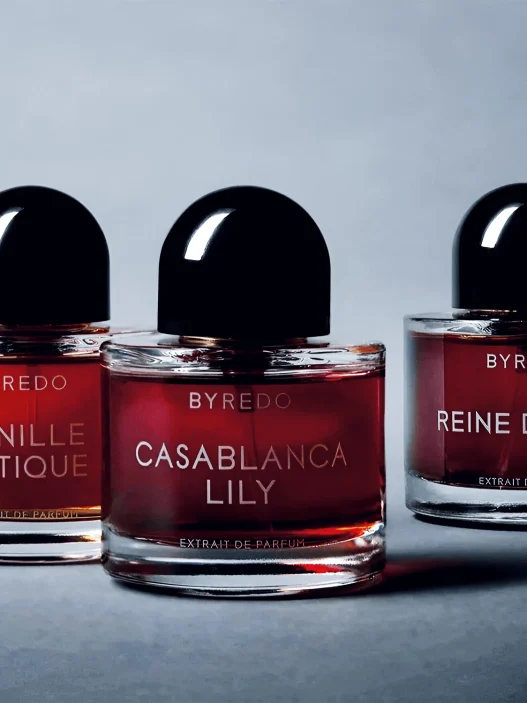
What has arguably done more to protect Byredo’s cultural standing than any product launch is the Absolu collection. The reception among serious fragrance consumers has been notably warmer than for the EDPs — reviewers consistently cite meaningfully better longevity and projection, with the Bal d’Afrique Absolu in particular generating the kind of enthusiastic community response that the original EDP never quite managed to sustain.⁹ The perfumer behind both, Robertet’s Jérôme Epinette, has described the Absolu approach as pushing the “franchise of those icons” rather than replacing them — an important distinction.¹⁰ If the Absolus are the version of Byredo that the fragrance community actually wanted, the brand has retroactively delivered on a promise it made in 2006 and only partially kept.
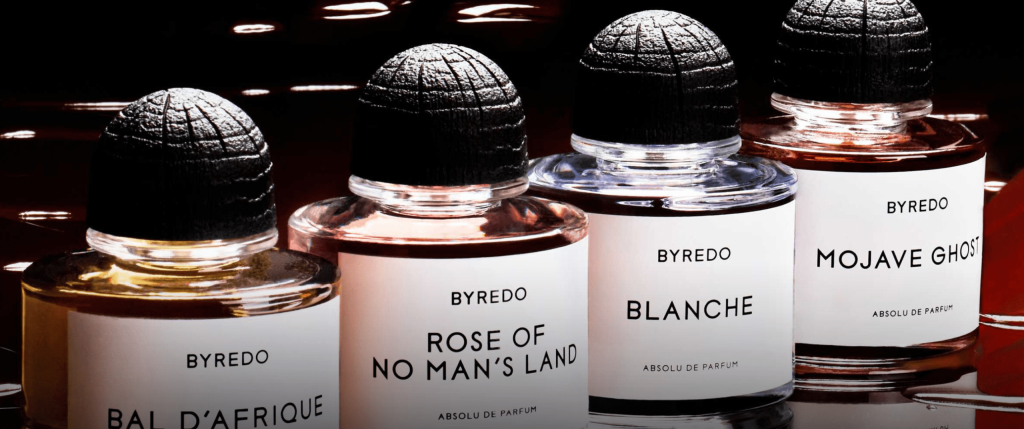
The dupe problem, however, is real and growing. TikTok’s fragrance community has catalogued affordable alternatives for every major Byredo EDP, and search behavior around “Byredo dupe” has increased substantially as the brand’s retail presence has expanded. This is the structural tax of scale: the more broadly distributed a niche brand becomes, the more valuable the dupe market around it grows. The Absolu and Extract tiers are, in part, a response to this — formulations of genuine complexity and concentration are meaningfully harder to replicate at $30 than a standard EDP. But the entry-level product remains exposed.
The Fragrance Market as Tailwind and Headwind
Understanding where Byredo sits requires understanding what is happening to fragrance as a category — because the tailwind that carried the brand from €62 million in 2019 to €119 million in 2021 is evolving in ways that do not uniformly favor its current positioning.
The broad numbers remain strong. Fragrance was the fastest-growing beauty category in the U.S. in 2024, up 12% in dollar sales, and luxury perfumes specifically saw a 15% increase.¹¹ The niche perfume segment, valued at approximately $2.39 billion in 2024, is projected to reach $8.12 billion by 2033 at a compound annual growth rate of 14.52%.¹² Higher-concentration formats are the clear market winner: U.S. sales of parfum formats grew 43% in 2024, with EDPs up 14%.¹³ Byredo’s tiered strategy is aligned with this shift, not incidentally.
But within the boom, the first credible signals of fine fragrance fatigue are emerging. Business of Fashion characterized the current moment in mid-2025 as the arrival of a “looming sense of fine fragrance fatigue” even as the broader category grows.¹⁴ Earned media value on Instagram for fragrance dropped 12% in Q1 2025 compared to Q1 2024, against a broader beauty decline of 28%.¹⁵ The discovery-driven, social-media-fueled frenzy that launched a thousand niche brands between 2020 and 2023 is beginning to consolidate. Consumers are becoming more intentional: research indicates 62% of fragrance buyers in key markets now prefer investing in one quality fragrance over multiple cheaper alternatives.¹⁶ That consumer behavior actually favors Byredo’s high-margin Extract tier if the brand can successfully position it as the considered, deliberate choice. It is less favorable for the brand’s mid-range EDPs, which sit in an increasingly crowded masstige corridor where Le Labo, Diptyque, Maison Margiela’s Replica line, and a growing number of Korean niche brands are competing for the same wallet.
The direction of the fragrance market in 2026 is also moving aesthetically toward territory that Byredo’s current identity does not obviously own. BeautyMatter’s industry forecasters describe the dominant 2026 fragrance mood as “chaotic, irreverent, and boldly imperfect” — a cultural rejection of the kind of controlled, minimalist refinement that Byredo has always represented.¹⁷ Separately, analysts note a consumer shift toward intentional close-to-skin scents with quieter projection and “less-is-more” compositions.¹⁸ Neither of these vectors is Byredo’s natural home. The brand was built for a cultural moment that valued clean, considered restraint. That moment is not over — but it is competing with louder, stranger energies that Byredo, now operating without its founder, is not architecturally positioned to embody.
All things considered
Byredo is not falling. The underskin thesis, while culturally perceptive, overstates the immediacy of the decline. The brand is growing within Puig’s portfolio and continues to outperform its peer niche brands on a like-for-like basis. The Absolu collection has meaningfully rehabilitated the brand’s standing among its most skeptical consumers. The retail expansion into Japan and the continued strength in the Americas suggest the brand has genuine geographic runway remaining.
But there are real structural pressures that deserve honest accounting. The departure of Ben Gorham in June 2025 removed the brand’s most important intangible — its narrative coherence.¹⁹ Gorham was not just Byredo’s creative director; he was the reason the brand’s origin stories were credible, the reason its entry into new categories felt authored rather than commercially motivated, the reason a journalist could write about Byredo and have something to say beyond product features. Puig is an experienced operator of founder-led brands — Charlotte Tilbury operates within the group with considerable independence and continued commercial momentum — but Byredo presents a harder case, because Gorham’s personal narrative was woven more deeply into the product than almost any other founder in the niche fragrance space.
The tiered pricing architecture is clever and well-executed, but it introduces a tension that the original brand never had to manage. Byredo’s power was rooted in simplicity — a single price point, a single concentration, a single clear proposition. The introduction of three tiers at $235, $290, and $465 makes the brand more commercially sophisticated and culturally more complex to read. For the existing customer who loved Byredo precisely because it did not make them think too hard about hierarchy, that complexity is not costless.
What the next 12 months will reveal is whether Puig’s post-Gorham creative leadership can do what no one has convincingly done in niche fragrance: sustain cultural authority after the founder’s exit, in a slowing market, at a premium price point, with a broadening product range, without the gravitational center that made the whole thing cohere. The numbers, for now, say yes. The culture is not yet sure.
Sources
- TheIndustry.beauty / Luxury Tribune, February 2026
- Luxury Tribune / Ara.cat, February 2026
- Ara.cat, February 2026
- Business of Fashion, October 2025
- Puig Q1 2025 press release / Glossy, January 2025
- Glossy, April 2025
- Element Brooklyn, May 2025
- Byredo official site, current product listing
- Fragrantica / Parfumo, Bal d’Afrique Absolu community reviews, 2025
- Glossy, April 2025
- Glossy, February 2025
- Data Horizzon Research, November 2024
- Glossy, April 2025
- Business of Fashion, August 2025
- Industry Research Biz, fragrance market report, 2026
- Cosmetics Design Europe, January 2025
- BeautyMatter, February 2026
- BeautyMatter, February 2026
- Modaes Global, September 2025







Hi, this is a comment.
To get started with moderating, editing, and deleting comments, please visit the Comments screen in the dashboard.
Commenter avatars come from Gravatar.