
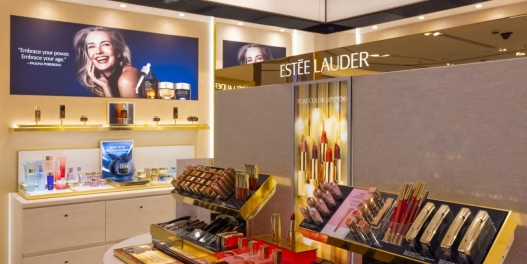
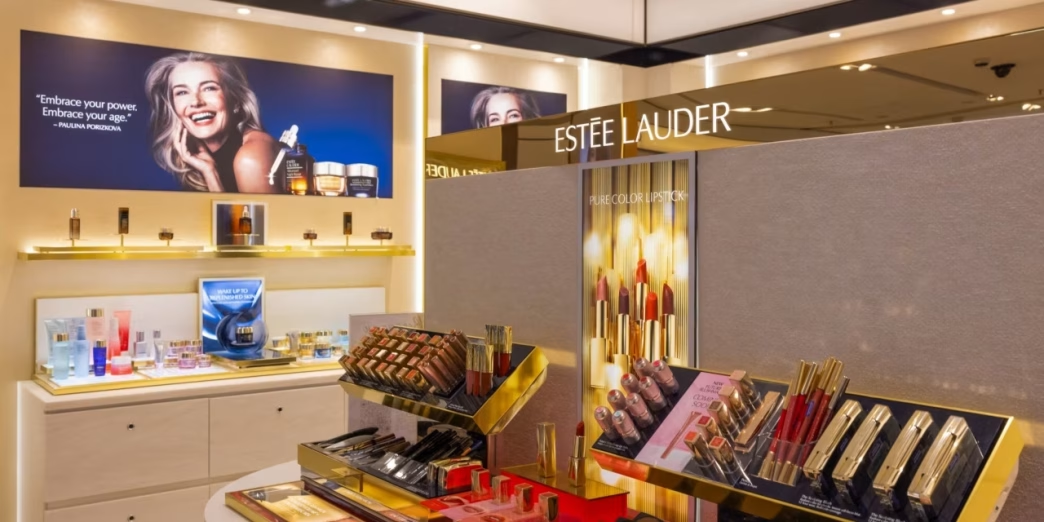
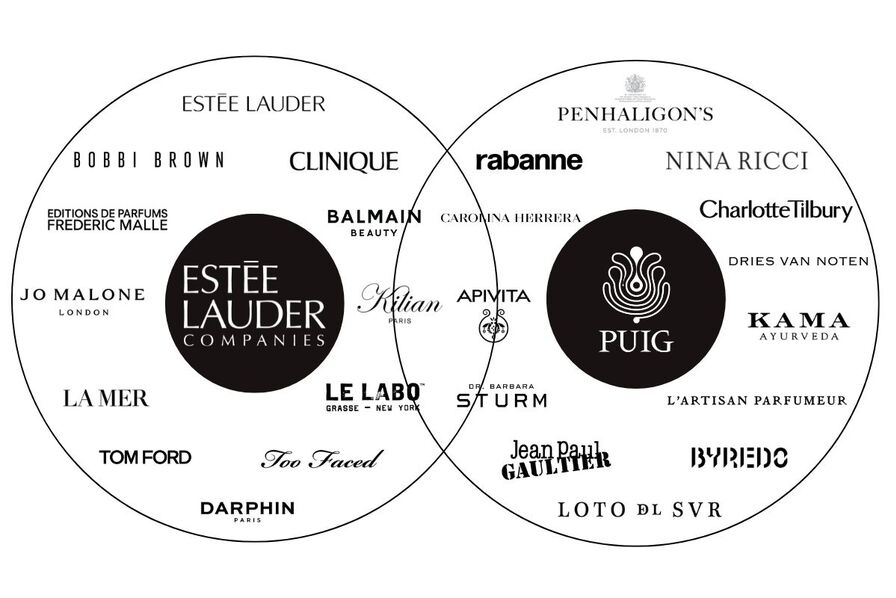
Estée Lauder Companies and Spain’s Puig Brands have confirmed they are in active discussions about a business combination that would create a $40 billion beauty conglomerate with roughly $20 billion in annual revenues. Bloomberg reported on April 1 that negotiations have advanced significantly, with a formal announcement potentially coming within weeks. The deal, structured primarily as a stock swap, would unite Lauder’s Le Labo, Jo Malone, and Tom Ford with Puig’s Charlotte Tilbury, Byredo, Rabanne, and Jean Paul Gaultier — assembling one of the most consequential fragrance portfolios the industry has ever seen under a single roof. Estée Lauder’s stock fell nearly 8% on the initial report while Puig’s shares rose 13.4%, a spread that tells you everything about who the market believes has more to gain.
The most revealing number in this story is not the $40 billion valuation. It is the 8% drop in Estée Lauder’s share price on the day the talks became public. Markets read the announcement not as a triumph but as a distress signal — and they were not entirely wrong. Lauder is still navigating a prolonged turnaround after years of declining sales, executive instability, and a brutal reckoning with its overexposure to Chinese travel retail. That context matters enormously here, because it reframes the entire narrative of this deal. This is not a story of a dominant company making a bold acquisition from a position of strength. It is a story of two companies converging around a shared vulnerability: neither can credibly challenge L’Oréal alone, and both know it.
What makes Puig the more compelling half of this equation is something Lauder has conspicuously lacked for years: a coherent and growing fragrance architecture. Fragrance is now the most structurally resilient category in luxury beauty, outpacing skin care in both growth trajectory and margin durability, and Lauder’s relative weakness there has become increasingly difficult to ignore as the category has accelerated. Puig’s portfolio was not assembled by accident. After L’Oréal stripped Puig of key fragrance licenses for Valentino and Prada — a competitive wound the industry has long referred to as “la guerre” — the Barcelona-based group pivoted deliberately away from licensing toward outright brand ownership. The acquisitions of Charlotte Tilbury and Byredo were not opportunistic. They were the deliberate construction of a new kind of beauty conglomerate, one built around cultural credibility rather than legacy scale.
There is a particular irony, then, in Lauder now seeking to acquire access to assets it twice failed to win through competitive bidding. Charlotte Tilbury and Byredo were both processes in which Estée Lauder was involved and lost. The combined portfolio that would result from this merger — Le Labo, Jo Malone, Tom Ford Beauty, By Kilian, Frederic Malle, Byredo, Rabanne, Jean Paul Gaultier, and Carolina Herrera — would represent the single most powerful assembly of fragrance intellectual property outside of L’Oréal and LVMH. That is not a minor footnote. In a market where fragrance is increasingly the primary driver of prestige beauty growth, this deal is essentially a bid to buy a seat at a table Lauder had largely been locked out of.
The geographic asymmetry further sharpens the strategic logic. Puig’s Asia-Pacific revenues represented just 11% of net revenue in 2025, while Lauder’s brands — Jo Malone and Tom Ford in particular — have already established meaningful footholds in mainland China. Analysts at Baird have noted specifically that a combined entity could deploy Lauder’s China infrastructure behind Puig’s fragrance brands, particularly Byredo and Charlotte Tilbury, where the growth potential in that market remains substantially underdeveloped. That is a concrete, near-term value exchange that is easier to execute than a full operational integration.
The harder question — the one that analysts are not fully pricing in yet — is what this merger does to the brands themselves. Both families have structured the deal to preserve voting control, which reflects a shared instinct to maintain creative authority over their respective portfolios. That instinct is correct. The brands in this combined entity, across the board, derive their value from a perception of independence, curation, and cultural specificity. Byredo is not Byredo because of Henkel’s distribution infrastructure. Charlotte Tilbury is not Charlotte Tilbury because of legacy conglomerate marketing. The moment either portfolio begins to feel like it is being managed for synergies rather than for culture, the erosion starts. The next 6–12 months will not be defined by whether the deal closes. They will be defined by the integration philosophy that emerges on the other side — and whether the combined leadership has the restraint to let their best brands continue to operate as though the merger never happened.




I love how your posts are always so well-structured and easy to follow. Keep it up!
Your content is a go-to source for me when I need information. Great work, as always!
Thank you, for your kind words. I\’m committed to maintaining the quality of my posts.