



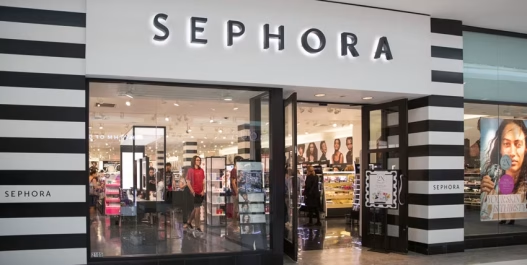
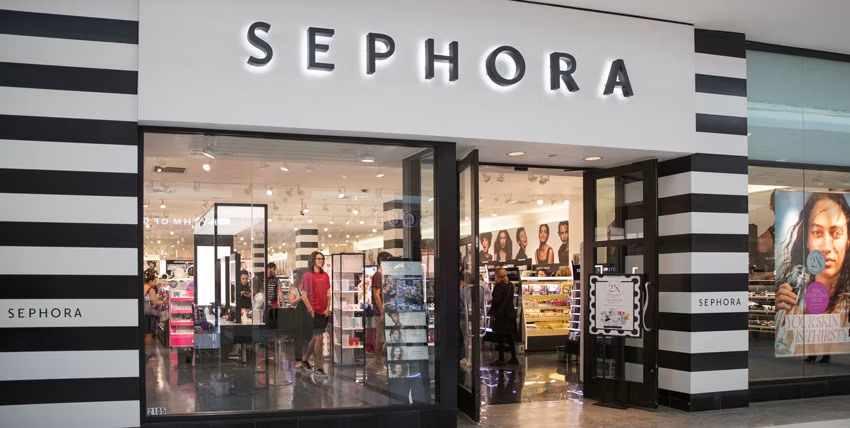
This week, Sephora became the first prestige beauty retailer to enable end-to-end shopping within Google’s AI-powered ecosystem, allowing customers to discover products, receive personalized recommendations, build routines, and complete purchases entirely within Google’s platform through a new capability called Google Agentic Checkout — without visiting the Sephora site or app at any point in the transaction.¹ The announcement follows Sephora’s March 2026 integration within ChatGPT, which allowed shoppers to use Beauty Insider loyalty points and perks directly inside the OpenAI interface, and Ulta Beauty’s near-simultaneous Google Gemini partnership announced in April, which surfaces Ulta’s assortment across AI search and enables conversational checkout within Gemini.² The two moves, arriving within weeks of each other, formalize something the beauty industry has been circling for two years: AI platforms are no longer just search engines. They are the new retail floor. And the brands and retailers that control the data layer inside them will control the category.
The number that reframes this entire story is one that arrived in the same week: Amazon sold $8.1 billion worth of beauty products in Q1 2026 alone, a 13% increase from the same period a year prior.³ That figure, reported by Front Row, represents quarterly beauty revenue that places Amazon in a category of its own among beauty retailers — larger, by a significant margin, than any single specialty channel and growing faster than either Sephora or Ulta in absolute dollar terms. The context in which Sephora announced its Google Agentic Checkout partnership is therefore not simply about innovation or convenience. It is about a major specialty retailer watching the competitive landscape shift in real time and making the most consequential distribution decision available to it: embedding itself inside the AI discovery infrastructure that its most important consumer demographic is already using as a primary search and shopping interface.
The data on how consumers are actually using AI for beauty is no longer speculative. According to NielsenIQ figures cited in industry briefings this month, consumers conduct over one billion beauty-related searches per week on ChatGPT.⁴ An April 2026 report from Tinuiti states that more than a third of all beauty shoppers — and over half of Generation Z — are using AI to research or purchase products.⁵ These are not marginal behaviors. They describe a structural shift in where beauty discovery is happening, one that is moving faster than most brands’ digital infrastructure was built to accommodate. The brands and retailers that are present inside these AI environments with accurate product data, trained recommendations, and seamless checkout will accrue discovery advantages that compound over time in the same way that early Sephora shelf placement did in the 1990s and early SEO dominance did in the 2000s.
The strategic architecture of what Sephora is building is worth examining in detail, because it reflects a sophisticated understanding of what AI commerce actually requires. The Google Agentic Checkout integration is the most recent layer in a stack that also includes Sephora’s proprietary AI Beauty Chat on its own website and app, AI-enabled skin diagnostics across physical and digital channels, and now the ChatGPT integration.⁶ Nadine Graham, general manager of e-commerce at Sephora North America, was unusually direct about the underlying logic at the Glossy E-Commerce Summit this week: the large language models are where consumers are beginning their discovery journeys, and the only reliable way to ensure that product data is accurate, brand-safe, and properly representative inside those environments is to have a formal partnership with the platforms themselves.⁷ This is a significant statement from an executive at the world’s largest beauty retailer. It is an acknowledgment that the organic information environment inside AI platforms is insufficiently controllable for a business built on premium brand experience, and that control requires formal commercial relationships — not just good SEO.
The competitive dimension with Ulta is equally interesting. Sephora embedded inside ChatGPT, Ulta embedded inside Google Gemini, both pursuing the same fundamental objective through different platform relationships — this is not coincidence. It reflects a recognition by both retailers that the two dominant AI consumer platforms represent the most important future distribution infrastructure in beauty retail, and that exclusive or preferred partnerships with each create a meaningful asymmetry over competitors who remain platform-agnostic. The question that neither Sephora nor Ulta is publicly addressing is what this means for the brands on their shelves. When a consumer asks a Google Gemini assistant for a recommendation on a vitamin C serum and Ulta’s assortment is the curated universe from which the answer draws, the brand within that assortment that the algorithm surfaces most frequently accrues a structural advantage over every brand that sits in the physical store but is less well-represented in the training data or product catalog integration. The new shelf placement battle is invisible, algorithmic, and already underway.
The Amazon comparison is the piece of context the specialty beauty industry most wants to avoid confronting directly. Front Row’s data showing $8.1 billion in Q1 beauty revenue is not simply a competitive benchmark. It is evidence that Amazon has spent years building exactly the kind of AI-driven recommendation and discovery infrastructure that Sephora and Ulta are now attempting to access through third-party partnerships.⁸ Amazon’s algorithm has years of purchase data, search data, review data, and behavioral data that no LLM partnership can replicate in a single integration cycle. What Sephora and Ulta are racing to build is a version of that discovery infrastructure on platforms where Amazon is not the default. The six to twelve months ahead will reveal whether the specialty channel’s curatorial authority and brand equity are sufficient competitive advantages inside conversational AI — or whether the consumer, when given a frictionless AI-powered recommendation, defaults to the platform with the most comprehensive data regardless of which retailer badge appears at checkout.
Sources
- Glossy / CEW Headlines, June 2026
- Glossy, May 2026 Glossy / Front Row data, June 2026
- NielsenIQ / Glossy, June 2026
- Tinuiti, April 2026 Glossy, June 2026
- Glossy E-Commerce Summit, June 2026
- Glossy / Front Row, June 2026
- CNBC / WWD, April 22–23, 2026