





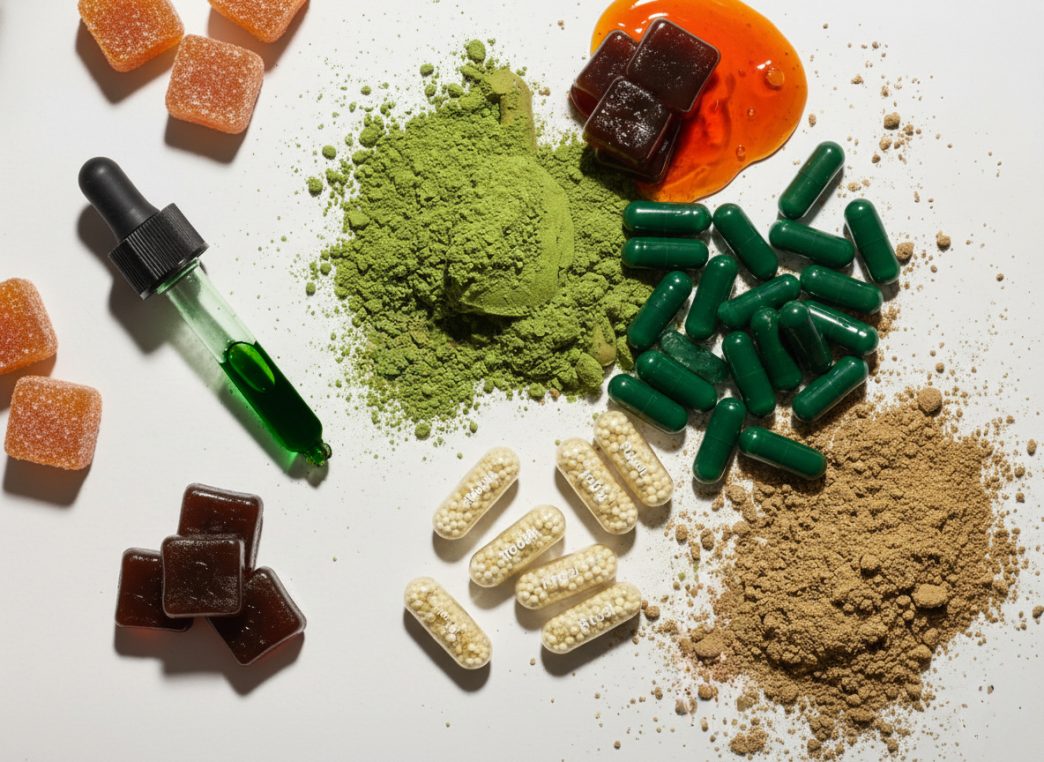
Can we treat wellness like a serum? Beauty keeps trying. The category keeps resisting.
Wellness is the next hill for beauty to climb. But it’s also a cliff.
The optimism is real, and it’s not hard to see why. Beauty retail is maturing, growth is harder, and “wellness” looks like an adjacent continent with an enormous total addressable market. Ulta has been methodically widening its wellness footprint and framing it as a bona fide pillar (including renaming and expanding how it talks about ingestibles inside its wellness segmentation). (Women’s Wear Daily) And while the venture cycle has cooled versus the peak years, the broader “health-from-within” ecosystem still attracts serious capital and attention—especially where it interfaces with outcomes (nutrition care, diagnostics, longevity), not just vibes. (Business Insider)
Thanks for reading! Subscribe for free to receive new posts and support our work.Subscribe
It’s the story analysts and retailers want: beauty customers already spend on themselves, they’re already primed for “routine,” and wellness promises repeat purchase. Subscriptions. Stacks. A lifetime LTV curve that makes a moisturizer look like a one-night stand. In that framing, wellness is not a detour. It’s the next logical aisle.
But here’s the catch: this isn’t the first tango between beauty and wellness.
Wellness 1.0 was not a clean win
We already ran a mass-market experiment—call it Wellness 1.0—with brands like Moon Juice, Sun Potion, The Beauty Chef, WelleCo and the general “beauty-from-within” wave that rode alongside Goop-era cultural power. It created iconic products, distinctive aesthetics, and a certain kind of consumer identity. What it did not reliably create was a scalable, broadly comprehensible value proposition with consistent retention across a wide audience.

Moon Juice is a useful case study because it shows both the cultural peak and the operational messiness beneath the sheen. Reporting has documented internal turmoil and layoffs, the kind of friction that tends to appear when a brand’s mythology outruns its fundamentals. (Business Insider) And more recently, Moon Juice has closed its physical retail location—a meaningful move for a brand that once treated community and ritual as part of the experience itself. But the deeper signal is directional. Moon Juice was one of the earliest modern wellness-first brands—an icon of Wellness 1.0. And over time, rather than doubling down on ingestible wellness as the center of gravity, it has increasingly moved closer to beauty.
That combination matters. The storefront wasn’t just a sales channel; it was part of the trust architecture. And the migration toward beauty isn’t just diversification; it’s a search for legibility—faster feedback loops, lower epistemic burden, and a category where consumers are more willing to experiment without needing clinical proof. In other words, even the pioneers of wellness eventually find themselves borrowing beauty’s physics to stay scalable. The shift itself is a clue: wellness is harder to retain, harder to prove, and harder to build durable belief around than the industry wants to admit.
Then there’s the core product issue. A lot of Wellness 1.0 was built on claims that were either:
- too metaphysical to be falsifiable,
- too technical to be legible, or
- too “dominant benefit”-driven in a way that collapses under basic scrutiny.
WelleCo’s flagship Super Elixir was marketed heavily through the “alkalising/alkalizing” lens—an idea that sounds clinical to the average consumer, but runs into the reality that the body regulates pH aggressively (so the promise can feel like a marketing costume more than a physiological lever). (patigroup.com)
Sun Potion is the opposite problem: it goes so deep into tonic herbology and TCM-adjacent mythology that it can cross from “ancient tradition” into claims that are difficult to validate through conventional clinical frameworks, especially when the claims are broad and the average consumer can’t distinguish reverence for tradition from evidence for outcomes. (That doesn’t mean plants don’t do anything; it means brands often ask consumers to accept a full worldview when most people just want a measurable improvement.) (Fortune)
Another signal that undermines the “wellness is the next beauty” thesis is how quickly brands abandon conviction when trends shift.
Consider Juna. Juna originally launched squarely inside the CBD boom — positioned as a beauty-adjacent, female-forward, elevated take on cannabidiol. CBD was framed as the active: calming, balancing, modern, and culturally ascendant. For a moment, it checked all the boxes wellness investors and retailers wanted.
Then the CBD wave broke.
Regulatory ambiguity persisted, differentiation collapsed, efficacy remained inconsistent for most consumers, and the category rapidly commoditized. What followed was not iteration — it was retreat. Juna quietly deprioritized CBD and re-emerged oriented around digestive enzymes, gut health, and general metabolic support, aligning itself with the next dominant wellness narrative: digestion as the root of everything.
On paper, this pivot looks strategic. In reality, it exposes the fragility of the model.
What changed was not Juna’s underlying thesis about health. What changed was what the market was willing to buy. Digestive health became the new permission structure — fueled by the rise of probiotics, microbiome discourse, bloating anxiety, and social media normalization of gut talk. The brand followed the current.
This is the critical distinction: a trend-driven pivot is not the same thing as scientific evolution.
In beauty, reformulation and category expansion are often additive. A brand can launch a serum after a cleanser without invalidating its prior worldview. In wellness, abandoning a hero active — especially one positioned as foundational — quietly tells consumers that the earlier certainty was provisional. That erodes trust, even if it doesn’t cause immediate churn.
Juna’s move also highlights a deeper issue: wellness brands are often built around marketable narratives, not physiological frameworks. CBD, digestion, adaptogens, enzymes — these are not interchangeable mechanisms, even if they are interchangeable slides in an investor deck.
And consumers notice.
When a brand migrates from CBD to digestion because digestion is now the cultural obsession, it reinforces the suspicion that the product roadmap is being reverse-engineered from trend velocity, not from long-term conviction about outcomes. The result is a subtle but cumulative loss of credibility: if everything is “the key,” then nothing is.
This is not unique to Juna — it’s endemic to the category. Wellness brands routinely behave like content studios chasing relevance rather than healthcare-adjacent entities earning trust. The problem is that wellness consumers don’t evaluate products the way they evaluate skincare. They may tolerate experimentation in beauty. In wellness, experimentation feels personal.
Which brings us back to the core fault line.
Wellness cannot be trend-chased the way beauty can. You can’t rotate “hero ingredients” every 18 months and expect consumers to believe each one was essential. When brands do this, the subtext becomes unavoidable: the business needed a new growth story.
That’s why these pivots matter more than any single product failure. They reveal that many wellness brands are structurally designed to follow cultural heat, not physiological truth. And once consumers internalize that, the category stops feeling like self-care and starts feeling like a monetization cycle.
This is also why Sephora’s pullback, AG1’s marketing-heavy dominance, Seed’s slow-feedback challenge, and Juna’s pivot all rhyme.
They’re not isolated stories. They’re symptoms.
Wellness isn’t failing because consumers don’t care. It’s failing because too many brands treat belief as interchangeable — and in a category this intimate, belief is the product.
Even the brands that did achieve scale often did so by collapsing complexity into candy: gummies, powders that taste like dessert, daily “ritual” formats that are essentially compliance hacks. Which brings us to the current moment.
The signal that should make everyone nervous: Sephora walked away
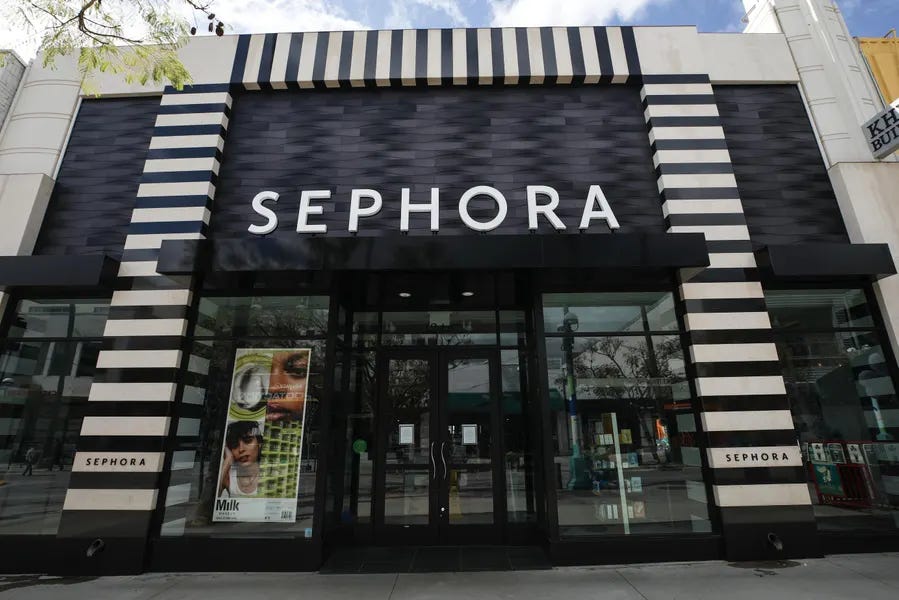
If wellness was simply “the next aisle,” Sephora would be leaning in. Instead, Sephora is sunsetting supplements. No hedging, no soft repositioning—an exit. (Beauty Independent)
That matters because Sephora is not just a retailer. It’s an education machine, a cultural interpreter, and one of the best-in-class operators at turning novelty into habit. So when Sephora can’t make supplements work at meaningful scale—despite having the shelf, the traffic, the sampling playbook, and the conversion engine—it’s not a minor data point. It’s a thesis stress test.
Beauty Independent’s reporting (following Business of Fashion’s scoop) frames Sephora’s move as part of a broader retreat from wellness; it even notes prior pullback from sexual wellness products as well. (Beauty Independent) In other words: Sephora tried “wellness” more than once, and it keeps not fitting.
Why might that be?
Because wellness does not behave like beauty. And Sephora’s decision wasn’t aesthetic. It was structural.
Wellness buying behavior is structurally different than beauty buying behavior
Beauty is one of the most efficient consumer categories ever invented. It sells:
• fast sensory feedback (texture, scent, glow),
• short-cycle perceived results (hydration, radiance, smoothing),
• visible “treat” energy (packaging, ritual, indulgence),
• and low perceived downside (most consumers treat a new serum like a flirtation, not a risk).
Wellness—especially ingestibles—is the opposite. The consumer is implicitly asking: Will this change my body? Will it interact with my meds? Is it safe? Am I being scammed? The payoff is slower, often invisible, and heavily dependent on adherence. And adherence is where the whole dream gets fragile.
Retailers love to talk about repeat purchase, but repeat purchase is not the same as retention. A sunscreen loyalist is loyal because the result is immediate (comfort, finish, performance) and the consequence of quitting is obvious (burning, sensitivity, pigment). A sleep supplement buyer may not know whether the product “worked,” whether their life simply calmed down, or whether they placebo’d themselves into a better week. The experience is under the hood. It requires habit, not a treat.
This is also why the category is unusually prone to “carrot on a stick” monetization: subscriptions that quietly become the product-market fit. But subscription mechanics can’t permanently compensate for weak conviction.
The uncomfortable truth: “healthy” is rarely pleasurable—so what actually sticks?
At the center of wellness is restraint: better sleep hygiene, lower alcohol, more fiber, fewer ultra-processed foods, consistent movement, stress management. The healthiest things are often not the most “fun” things.
So what does scale in wellness DTC?
Compliance candy.
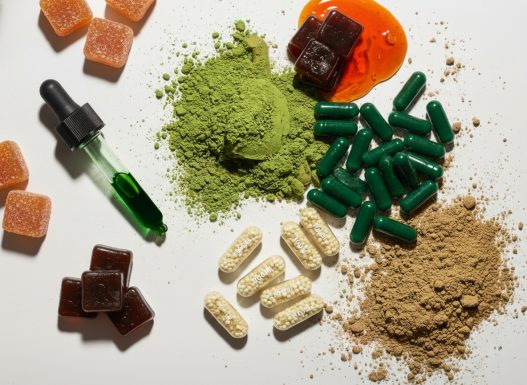
Gummies are the perfect consumer product because they solve the real problem (habit) while dressing up the hard truth (most people don’t want to swallow six capsules and change their life). They’re also the format most likely to blur the boundary between “supplement” and “confection.” This is wellness trying to borrow beauty’s pleasure loop—because pleasure converts faster than proof. Which is exactly why they sell.
But that should make beauty retailers pause, because it reveals the cliff: if the scalable version of wellness is the pleasurable version, you drift toward the edge of legitimacy. And once you’re flirting with legitimacy, you’re flirting with regulation, consumer backlash, and trust collapse.
Our take: Wellness is inevitable in America—and that’s exactly why beauty can’t treat it like beauty
The U.S. is uniquely fertile ground for wellness for a darker reason: the country’s health outcomes have been publicly deteriorating in ways that are rare among peer nations. U.S. life expectancy has seen periods of decline and disruption in recent decades, and the pandemic-era drop was historically sharp. (CDC)
Layer on a healthcare system that is expensive, difficult to navigate, and widely criticized as reactive rather than preventative, and you get a society where consumers are motivated to self-manage. Wellness becomes both aspiration and coping mechanism. And among affluent consumers, it becomes status-coded: the “informed,” optimized life as luxury.
So yes, wellness remains desirable. It remains lucrative. But it is not an industry that can run on the same playbook as beauty, because you can’t keep offering “silver bullets” to someone’s health without triggering the parts of the system that protect consumers.
A serum that overpromises is annoying. A supplement that overpromises is a lawsuit waiting to happen.
Which brings us to what brands are getting wrong—and what “getting it right” actually means.
What brands keep getting wrong
They ship product first and build credibility later.
Wellness is the category where that sequencing breaks fastest. In beauty, you can brute-force trial with aesthetics, influencers, and sensory seduction. In ingestibles, that approach creates an uncanny valley: the marketing feels like beauty, but the consumer expectation is medicine-adjacent.
Brands also keep confusing complexity with credibility. A 40-ingredient “stack” with exotic botanicals is not inherently more effective than a tight formula with a clear mechanism and dosing rationale. In fact, complexity often reads like a smoke bomb.
This is where the business model question becomes unavoidable: are the giants profitable, or are they brilliant customer acquisition machines funded by capital and momentum? The category has a long history of growth stories powered by marketing intensity—podcasts, influencers, affiliate flywheels—where the consumer ends up feeling like the monetization was the product. This question isn’t abstract — it shows up most clearly in the category’s biggest darlings.
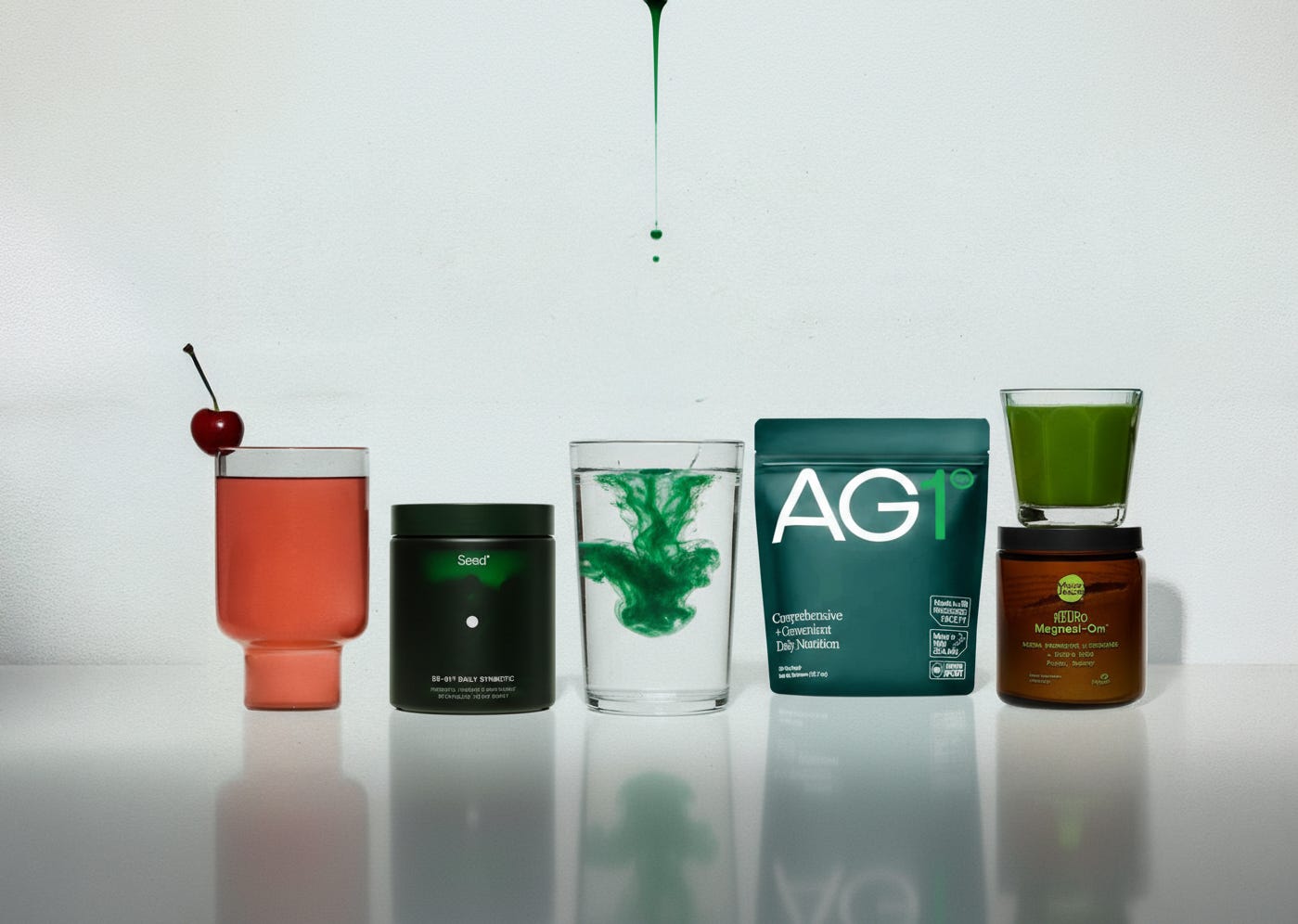
Take AG1. AG1 is often cited as the gold standard of modern wellness scale: massive brand awareness, ubiquitous podcast presence, near-total dominance of certain acquisition channels. But AG1 is also the clearest example of a wellness brand whose marketing machine is more visible than its unit economics.
AG1’s growth has been driven by extraordinary customer acquisition spend, particularly in podcast advertising and influencer affiliate flywheels. Estimates circulating in marketing and media circles have placed AG1’s spend at well into the seven figures per month, with some claims putting it north of $2 million monthly on paid and affiliate-driven media alone. Whether that exact figure is precise almost doesn’t matter — the signal does. This is a company that scaled by saturating attention, not by gradually compounding organic trust.

This tension became unusually visible when longevity entrepreneur Bryan Johnson publicly criticized AG1’s value proposition, arguing that the available clinical evidence did not justify its price or cultural dominance—prompting AG1 to respond and reigniting debate about how much “foundational nutrition” is marketing versus measurable effect. In other words, even within the optimization elite, the evidentiary floor is being questioned.
What’s notably opaque is profitability. AG1 is privately held, so margins are not public, but the persistent reliance on high-intensity acquisition raises a fundamental question: Is the product driving retention — or is the subscription architecture plus sunk-cost psychology doing the heavy lifting?
The formulation itself is another stress point. AG1 is positioned as a comprehensive “everything” solution — a daily greens powder meant to replace nuance with convenience. But that breadth creates two problems simultaneously:
- it’s difficult for consumers to attribute specific benefits to the product, and
- it encourages faith-based adherence rather than outcome-based conviction.
In other words, many consumers stay subscribed not because they can feel a clear effect, but because stopping feels like giving something up “just in case.” That’s not loyalty — that’s behavioral inertia.
Now look at Seed, which occupies a different but equally instructive position.
Seed is, on paper, everything wellness claims to want to be: science-forward language, clinical framing, microbiome education, sustainability signaling, and a narrower product focus. But even Seed illustrates the structural tension in the category. Probiotics are inherently difficult to experientialize. Results are slow, subtle, and highly individual. The average consumer cannot feel microbiome modulation the way they can feel moisturized skin or smoother texture.
Seed’s brand leans heavily on education and credibility, yet the purchasing behavior still relies on long-term subscription commitment without immediate feedback. That creates a ceiling: the brand attracts highly informed, motivated consumers — but struggles to break into the broader “beauty-adjacent” audience that retailers covet. Again, profitability is not publicly disclosed, but Seed has raised substantial venture capital, which places it firmly inside the same pressure cooker: grow fast, justify scale, and eventually prove margins in a category where patience is required but capital is impatient.
This is the common thread wellness brands keep tripping over.
Growth stories in wellness are disproportionately powered by marketing intensity, not by consumer pull. Podcast hosts, influencers, affiliate codes, and omnipresent retargeting don’t just sell the product — they become the product. The consumer’s experience shifts from “this changed my body” to “this is everywhere, so maybe I should be taking it.”
That’s the danger zone. Because once consumers realize that what they’re really buying is participation in a marketing ecosystem, trust erodes quickly. And in wellness, erosion is fatal. A beauty customer might roll their eyes and try something new. A wellness customer stops believing — and leaves the category entirely.
This is exactly why Sephora’s exit matters so much. It suggests that even best-in-class retail, education, and discovery infrastructure cannot reliably convert wellness into the kind of emotionally rewarding, fast-feedback purchasing loop that beauty thrives on. And it’s why the “wellness is the next beauty” narrative keeps collapsing under scrutiny.
So yes — AG1 and Seed are important. Not because they’re failures, but because they expose the structural truth: wellness does not reward the same business behaviors that beauty does.
The brands that survive long-term won’t be the loudest or the most omnipresent. They’ll be the ones that can answer a harder question honestly: If we turned off paid acquisition tomorrow, would consumers still choose this — and would they know why?
That’s not a marketing question. That’s a trust question.
Even when the product is “good,” consumers can still sniff a money grab. And in wellness, that intuition is stronger because the stakes feel higher.
What brands are getting right
They build around outcomes, not aesthetics.
The more “serious” end of wellness—nutrition care, diagnostics, clinically studied interventions—keeps attracting capital because it can plausibly justify trust with measurable impact. (Business Insider) That’s a different universe than “adaptogen cosplay,” and it’s the direction that will ultimately force the entire space to mature.
They also build around adherence honestly, not magically. If the mechanism requires consistency, the brand should design for it: clear instructions, realistic expectations, transparent timelines, and language that respects the consumer’s intelligence. Not “manifest your glow,” but “here’s what this does, here’s what it doesn’t, here’s how long it usually takes.”
And crucially: they respect the boundary between food and drug. The brands that survive will be the ones that understand that wellness marketing is not just storytelling—it’s trust architecture.
So what does “getting it right” actually mean?
The counterexamples reveal the rule: wellness works when the promise is bounded, authored, and slow-compounding. It means operating on a fundamentally different logic than trend-led wellness. The brands that are quietly building durable customers are not trying to make wellness behave like beauty. They are doing the opposite: narrowing scope, slowing the promise, and grounding their products in outcomes that are legible enough to trust—without drifting into medical overreach.
First, they anchor credibility in authorship and domain alignment. In wellness, the question of who decided this and why matters as much as what’s inside the product. This is where brands like Par Olive are instructive. Par Olive operates squarely in the ingestible beauty lane—developed in collaboration with dermatology and longevity expertise, produced under strict regulatory standards, and designed to complement topical skincare rather than compete with it. The product is not framed as generalized “wellness,” nor as a lifestyle system. It has a defined role within a broader skincare context. The consumer is not asked to adopt a philosophy; they are given a function. That clarity is a form of risk reduction.
Second, they define a specific function, rather than offering totalizing solutions. One of the most persistent failure modes in wellness has been the “do-everything” product—the greens powder or supplement positioned as a catch-all for modern life.
By contrast, brands that succeed articulate boundaries. MIJA is a clear example. Its hero supplement, Superstar, is not positioned as a miracle powder or a substitute for nutrition itself. It is framed as a baseline intervention—designed to fill clinically relevant nutritional gaps, not to promise transformation. That restraint is precisely what makes the proposition credible.
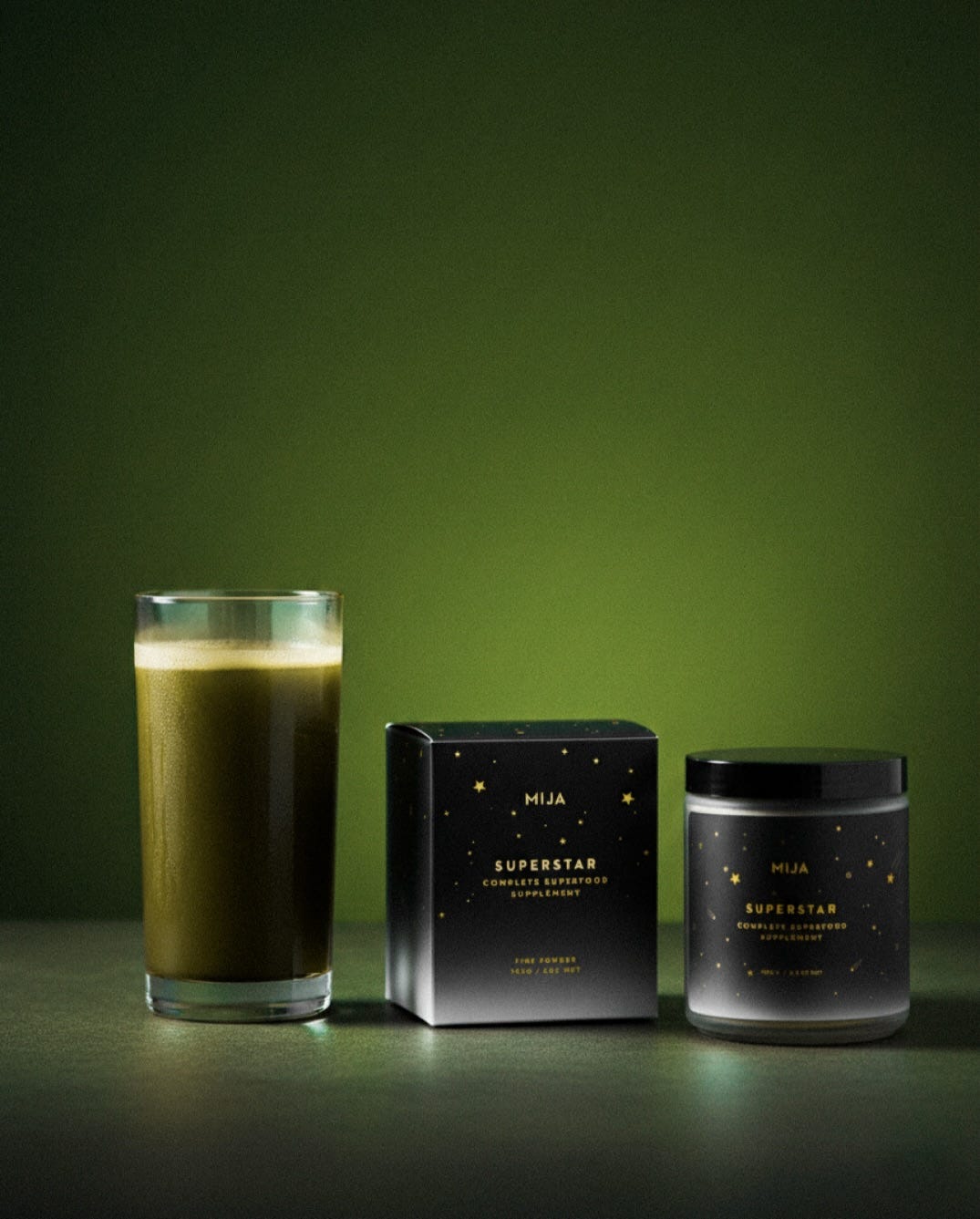
Third, they tie trust to outcome logic, not hype. MIJA’s formulation story is inseparable from its authorship: founded and formulated by a dietitian nutritionist with decades of industry experience, the product offers consumers something rare in wellness—an origin they can meaningfully evaluate. That credibility is reinforced through third-party recognition aligned with clinical review rather than influencer momentum, including repeated “Best Supplement” distinctions from Eat This, Not That, a dietitian-reviewed platform. The signal here isn’t trendiness; it’s functional relevance over time.
There is also a quieter but telling operational signal: the brands getting wellness right are not built on acquisition aggression. MIJA notably does not rely on heavy paid social or omnipresent retargeting to drive growth. That’s not a constraint—it’s a filter. When a product is narrowly defined and outcome-led, it doesn’t benefit from being shouted about indiscriminately. It benefits from being found by the right consumer at the right moment. This kind of micro-scale growth may look inefficient by venture standards, but it produces something far more valuable in wellness: customers who understand why they’re buying, and therefore keep buying without coercion.
Finally, they preserve allure without dependence on trend cycles, often through deeply personal trust cultivation. Brands like Agent Nateur demonstrate this through founder-led resonance rather than paid scale.

Founder Jena Covello has cultivated her audience almost one by one, building a depth of loyalty that cannot be replicated through acquisition tactics. Rather than chasing reach, she invested in consistency—showing up repeatedly with the same worldview, the same formulations, and the same expectations of her customer. That kind of trust doesn’t convert fast, but it compounds. In a category where belief is fragile, Agent Nateur’s durability comes from having never treated belief as interchangeable. This is the kind of slow-compounding conviction Sephora’s aisle cannot manufacture.
What unites these brands is not scale or aesthetic polish—it’s restraint. They don’t overpromise. They don’t treat belief as interchangeable. They don’t confuse complexity with efficacy. And most importantly, they don’t ask consumers to gamble on their health for the sake of a compelling narrative.
This is the real dividing line in wellness. Not between science and beauty, but between brands that treat trust as a growth tactic—and those that understand trust is the product.
What it means to “get it right,” if you’re a beauty retailer or beauty brand
It means accepting that wellness is not “the next category.” It’s a different category with different physics.
If you’re building wellness inside beauty, the question isn’t “what’s trending.” The question is: what can we sell that we can defend—scientifically, ethically, and legally—without turning the consumer into the experiment?
Sephora’s exit is not proof that wellness is dead. It’s proof that wellness is harder than beauty—and that the cliff is real. (Beauty Independent)
Ulta’s steady expansion suggests the counter-thesis: that wellness can work if it’s merchandised with clearer role definition and a more intentional framework. (Women’s Wear Daily)
So the hill is there. But the cliff is, too.
Wellness will be the next frontier for beauty. And the brands that win won’t be the ones who shout the loudest. They’ll be the ones who treat wellness like what it is: a high-trust category where credibility is the product—and everything else is just for show.






I\’m so glad I found your site. Your posts are consistently excellent.
I\’m truly grateful for your support. Your positive feedback keeps me motivated.
Your content is a go-to source for me when I need information. Great work, as always!
Your dedication to providing quality content is truly admirable. I\’m a fan of your work.